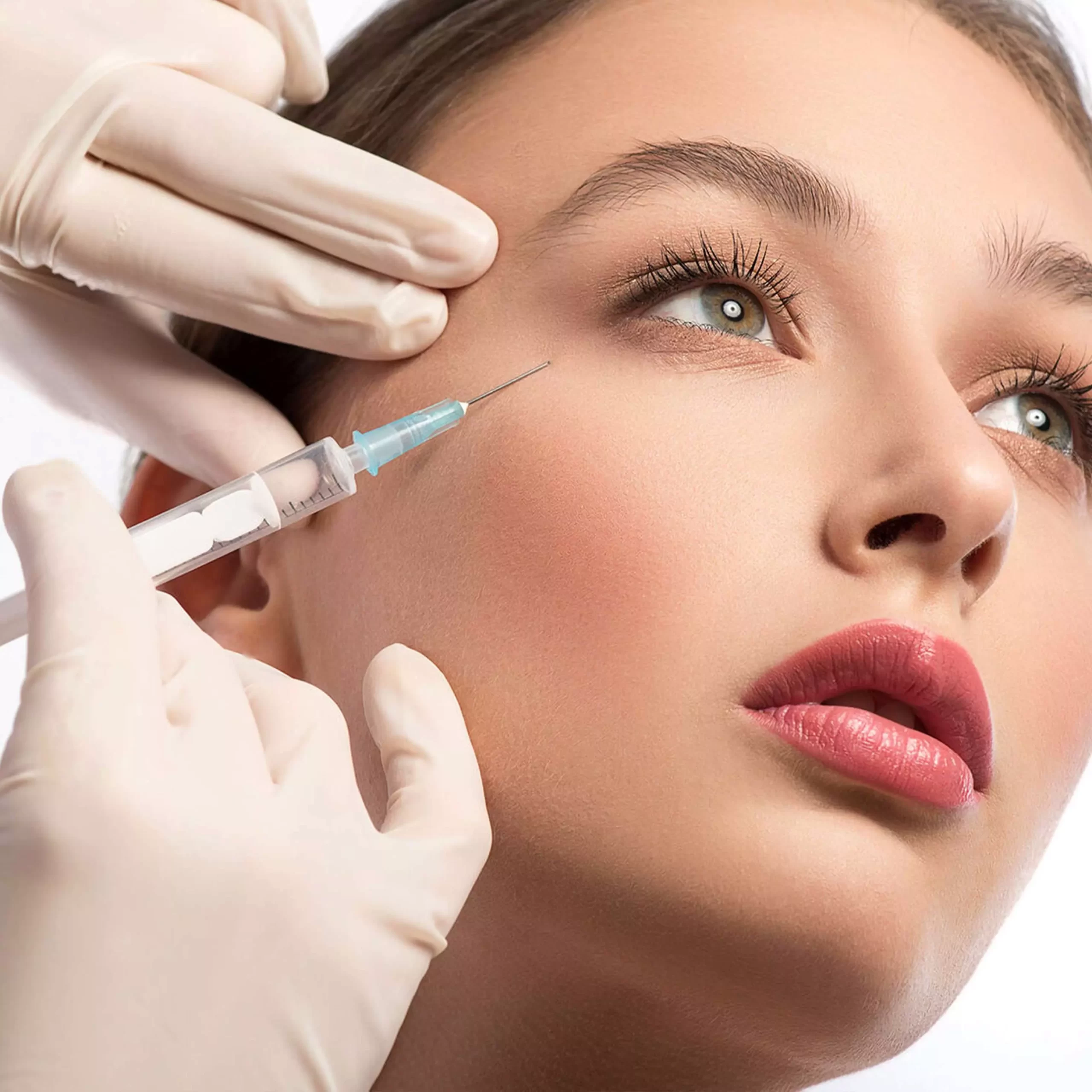
These are the two most commonly used substances in cosmetic medicine; it is essential to understand thedifferences between Botox and hyaluronic acid in order to use them properly.
Patients often confuse the two.
It’s not uncommon to hear comments like these when people talk about injections:“She got Botox in her lips!” “Her whole face is full of Botox!”
Two phrases we often hear, but which are inaccurate and amount to nothing more than wishful thinking.
It’s important to note that both of these products are used to temporarily reduce wrinkles on the face and neck.
But they don't serve the same purpose at all.
Botox is a neurotoxin used in cosmetic surgery to block the muscles responsible for expression lines. When used in medical doses appropriate for the face, it relaxes the muscles that cause wrinkles around the eyes, such as frown lines (between the eyebrows) or crow’s feet (at the outer corners of the eyes).
Botox can also easily reduce forehead wrinkles.
It can also lift the outer corner of the eyebrow to open up the eyes and make them appear more defined.
Finally, it targets the platysma muscle in the neck, which is responsible for those unsightly neck lines (from under the chin down to the décolletage).
The effects become visible within a few days, and Botox typically lasts for about six months.
The most well-known manufacturers of these molecules include Azzalure, Vistabel, Bocouture, and Dysport.
Contraindications for their use include pregnancy and breastfeeding, neuromuscular disorders (myasthenia gravis, dystonia), or patients taking anticoagulants.
The more the molecule is used, the less it needs to be used.
Since muscles retain a memory of their activity, this makes it possible to reduce the frequency of injections over time.
The molecule in question is a complex sugar that is a natural component of the dermis, binding together the skin proteins (collagen and elastin) responsible for tissue thickness. Aging has a quantitative effect on its production and its presence beneath the skin.
As we age, the skin thins out, becoming more delicate and revealing wrinkles, or losing its original volume. Hyaluronic acids come in various densities to meet aesthetic goals in plastic surgery.
Thus, thin lips, sagging cheekbones, pronounced nasolabial folds, and deep under-eye circles are excellent indications for these products.
The results are visible within 2 or 3 days.
They last for 4 to 6 months.
Brands such as Restylane and Teosyal are very well-known.
These products are most often combined with lidocaine (an anesthetic) to make the injection gentle or even painless.
Contraindications include pregnancy, breastfeeding, and patients taking anticoagulants.
Hyaluronic acid injections help maintain skin hydration and stimulate collagen production while adding volume where it’s needed.
With all this in mind, it’s impossible to confuse Botox with hyaluronic acid. You’ll go to the plastic surgeon with a specific request, without fear or anxiety.
If you have any other questions, feel free to ask them in the comments. I’d be happy to answer them.
Dr. Nicolas Zwillinger